Custom software
Applications built around a specific operating model instead of forcing the business into off-the-shelf constraints.

01Information technology practice
AOWN CLOTHING LIMITED is an IT company focused on custom software development, web applications, cloud infrastructure and systems integration. We work on products and internal platforms where correctness, maintainability and clear data flow matter more than novelty.
Engineering · Integration · Cloud · Quality assurance
02Who we are
We are a software engineering and technology consulting company. Despite the registered name, our work is entirely in information technology.
Our engagements usually begin with a process that has outgrown its tooling: a spreadsheet doing the job of a database, two systems that disagree about the same customer, a deployment nobody wants to run on a Friday. We start by understanding the mechanics of that process, then design and build software that fits it — documented, tested and possible to change later without a rewrite.
We work as a small, direct engineering team. There is no account layer between the people making technical decisions and the people who have to live with them.
03Core capabilities
Applications built around a specific operating model instead of forcing the business into off-the-shelf constraints.
Browser-based products and internal tools with predictable performance, accessible interfaces and clear data flows.
Environments, networking and deployment pipelines designed so releases are routine rather than risky.
APIs and data exchange between systems that were never designed to talk to each other.
Repetitive manual work replaced with reliable, observable workflows that fail loudly instead of silently.
Layered automated and exploratory testing that protects behaviour as the codebase keeps changing.
04Custom software development
Custom development is the right choice when the way a business works is itself the advantage. We model the domain in plain language first — entities, states, the rules that decide what is allowed — and only then choose frameworks and data stores.
Deliverables include the running application, its source repository with readable history, automated tests covering critical paths, deployment configuration and written documentation of the data model and integration points.
05Web application development
Customer-facing products, operational dashboards, admin tools and portals that replace manual coordination by email. Anything where several roles need different views of the same records.
Server rendering or static delivery where it helps first paint, considered client state, pagination and indexing planned around real data volumes, accessible semantics and keyboard support treated as requirements.
Budgets for bundle size and query latency set at the start. Slow pages are usually a data-access problem, so we profile queries before optimising markup.
Component structure, environment variables and build steps are documented so another team can run, extend and deploy the application without us.
06Cloud architecture and infrastructure
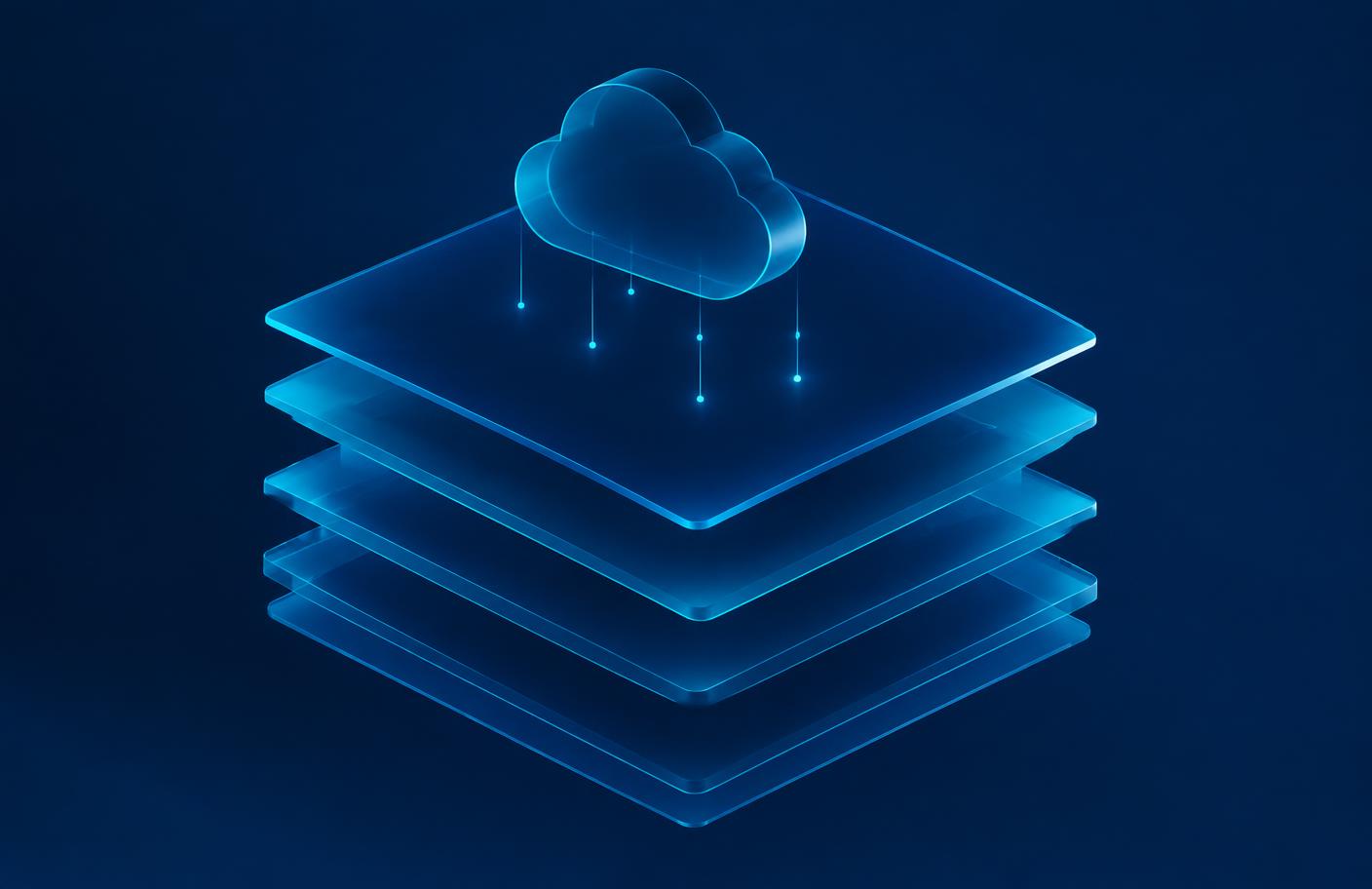
We design environments that can be rebuilt from their definitions: separated development, staging and production, least-privilege access, managed data services with tested backups, and deployment pipelines that run the same steps every time.
07Systems integration and workflow automation
Integration work starts with agreeing which system owns which field. From there we build services that exchange data predictably: idempotent writes, retries with backoff, dead-letter handling for messages that cannot be processed, and reconciliation reports that make divergence visible.
Automation follows the same discipline. Before scripting a task we document the manual steps, decide what should happen on failure, and define how a human is notified. An automation that fails quietly is worse than the manual process it replaced.
One system of record per field, documented and enforced.
Scheduled jobs, webhooks or queues chosen by latency requirements.
Retries, alerts and replay instead of silent data loss.
Reconciliation counts and mismatch reports after every run.
08Quality assurance and software testing
We work in layers: unit tests for logic and edge cases, integration tests across real boundaries such as databases and external APIs, and a focused set of end-to-end tests covering the journeys that must never break. Exploratory testing covers what automation cannot anticipate.
Every reported defect gets a regression test, so the same failure cannot return unnoticed. Test suites run in the pipeline on every change, and a failing suite blocks release rather than triggering a discussion.

09Delivery process
We map the current process, the systems involved and the constraints that cannot move. The output is a written understanding of the problem, not a proposal deck.
Work is broken into deliverable slices with explicit acceptance criteria, so progress is measured against agreed behaviour rather than percentages.
Data model, integration boundaries and deployment topology are decided before large amounts of code are written, and recorded in short decision notes.
Features ship in short cycles to a working environment. Each cycle ends with something reviewable, not a status report.
Automated tests, code review and exploratory testing run against every change. Defects found late are traced back to the gap that let them through.
Deployment is automated and repeatable, with monitoring, logging and a documented rollback path before launch day.
10Engineering principles
Most of a system's cost accumulates after the first release. These are the habits we apply from the first commit to keep that cost predictable.
Code is read far more often than it is written. We favour explicit structure and boring solutions that the next engineer can follow without a guided tour.
Modules have defined responsibilities and interfaces. Changing one area should not require understanding the entire system.
Automated tests describe intended behaviour. When requirements change, the test suite is updated first so intent stays visible.
Structured logging, health checks and error reporting are part of the feature, not a later retrofit after an incident.
Schema design, migrations and validation get attention early, because data problems outlive any user interface.
Architectural choices are written down with their trade-offs, so future changes start from context rather than guesswork.

11Collaboration and communication
You work with the engineers doing the work. Progress is shared in a regular written update covering what shipped, what is in progress and what is blocked. A shared backlog keeps priorities visible, and a working environment always reflects the latest accepted changes.
Anything that changes scope, cost or architecture is confirmed in writing before it is built. Uncertainty is reported as uncertainty — we would rather raise a question early than deliver a confident guess.
12Typical project scenarios
The scenarios below are generic illustrations of common situations in IT work. They are not descriptions of specific clients, projects or results.
A team coordinates orders across several shared spreadsheets. The work involves modelling the real process, building a web application with role-based access and an audit trail, migrating historical records, and running both systems in parallel until the data matches.
Two systems hold overlapping customer records with no synchronisation. The work involves defining a canonical record, building an integration service with retries and idempotent writes, and adding reconciliation reporting so drift is detected rather than discovered.
Deployments are manual and often rolled back. The work involves containerising the application, scripting environment provisioning, introducing a staged pipeline with automated tests, and adding monitoring so regressions surface before users report them.
An application works but nobody remembers how. The work involves reading the code against production behaviour, writing characterisation tests around critical paths, documenting the architecture, then refactoring the highest-risk areas incrementally.
Systems that must keep running are designed for the day they don't.
13Frequently asked questions
Custom software development, web application development, cloud architecture and infrastructure, API and systems integration, workflow automation, quality assurance, technical consulting, and ongoing maintenance of existing systems.
Both. Existing systems start with a review phase: reading the code, comparing it against real behaviour, and identifying the areas where change carries the most risk before anything is modified.
Scope is written as deliverable slices with acceptance criteria. Anything uncertain is named as an open question rather than hidden inside an estimate, and the plan is revised as those questions are answered.
Short architecture decision notes, a maintained test suite, consistent code structure, and readable commit history. The goal is that a new engineer can become productive without depending on any single person.
Technology choices follow the problem, existing infrastructure and the skills of the team that will maintain the result. We prefer widely supported, well-documented tooling over niche dependencies.
A regular written update, a shared backlog, a working environment that reflects the latest accepted work, and a direct channel for questions. Decisions that change scope or architecture are confirmed in writing.
Maintenance covers dependency and security updates, monitoring, defect fixes and incremental improvements, with a documented handover if an internal team takes over.
An email describing the problem, the systems already in use, any hard constraints and the outcome you need. That is usually enough to decide whether a technical conversation is worthwhile.
14Contact information
Helpful details to include: what the software should do, the systems already in place, the constraints that cannot change, and how you will know the work succeeded. Technical detail is welcome but not required.
All contact details on this site are shown as plain text.